
Providing comfort to the government on the revenue front amid fiscal stress, direct tax collection is moving closer to the revised Budget target for 2021-21 and may get a further thrust from the last instalment of the advance tax payment, the deadline for which ended on Monday. The contraction in net direct tax collection narrowed to 5 per cent year-on-year as on March 15 compared to a 9 per cent decline seen in January. In absolute terms, net collection stood at Rs 8.2 trillion against Rs 8.67 trillion in the same period last year, according to the provisional numbers shared by a government official.

Many states are open to the idea of petrol and diesel being brought under the goods and services tax (GST) regime - contrary to the perception that they are averse to it - but they want a concrete proposal, including a compensation mechanism, from the Centre. West Bengal Finance Minister Amit Mitra says while the issue can be discussed, the Centre may not be keen to bring the change because it earns "much more" from taxes on petrol and diesel. "(The peak rate of) GST is 28 per cent. Under the regime, the Centre would only get 14 per cent. "So, definitely, the Union government does not want GST on fuel. It is all lies. Currently, they are in a very cozy place," Mitra said.
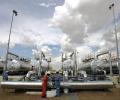
During a series of hectic talks between Cairn Energy and the Indian government over the $1.2-billion arbitration award in favour of the former last week, a slew of options was proposed by the two sides, including computation of capital gains and participation in the Vivad se Vishwas (VsV) dispute resolution scheme. The government is likely to go ahead and appeal against the arbitration award by a Permanent Court of Arbitration at The Hague before March 21, indicated finance ministry officials. Cairn Energy Plc on Sunday said it was hopeful that an acceptable solution to its tax dispute with the Indian government could be found to avoid prolonging and exacerbating the 'negative issue' for all parties.

The number of centrally sponsored schemes have increased to 35 in FY22 from 30 in FY21 and central sector schemes have increased to 704 from 685 in the previous year, reports Dilasha Seth.

The Budget proposed abolishing the under-performing, authority of advance ruling, to replace it with a two-member board of advance ruling.

'It is just an excuse to say that the Centre has run out of money.' 'Pruning these schemes would mean hard time for the people of India.'

While the tax-to-GDP ratio of 9.88 per cent has been assumed for FY21, the same as last year, when it touched a decadal low, for FY22 a ratio of 10.7 per cent has been assumed, an average of the last five years.

The biggest worry is not the shrinking of the labour market, but the collapse of good jobs.

'However, this time it looks like that is not working.'

The EPFO had decided that 8.15 per cent interest from its debt income would be credited immediately and the remaining 0.35 per cent capital gains from the equity sale would be given later, subject to its redemption.

The robust revenue collection reinforces hope of a good economic performance in the third quarter of financial year 2020-21 after the surprising pickup seen in Q2.

While the declarations under the scheme have to be filed by December 31, 2020, the government had in October extended the deadline for making payment by three months till March 31, 2021, in view of the ongoing Covid-19 pandemic.

The findings of the report showed consumer spending falling for the first time in over four decades in 2017-18.

Personal income tax saw contraction shrink to 13 per cent by November from 22 per cent seen up to September, on the back of lower issuance of refunds and improvement in economic conditions.

Under the Atmanirbhar Bharat Rozgar Yojana announced by the Centre to incentivise formal sector job creation, all 'new employees', who were never a part of the EPF system in the past, and those who made an exit from employment during the Covid-19 pandemic from March 1, 2020, to September 30, 2020, will be eligible for the benefit.

The Code on Social Security, 2020 gives a lot of comfort to gig firms which recognise cab drivers or food delivery executives as 'independent contractors' who directly do business with customers with the help of their digitised platforms.

Outlay for infra is also expected to see a significant increase in view of the government's Rs 111-trillion investment plan under the national infrastructure pipeline to develop social and economic infrastructure over five years.

The norms, say industry experts, are not sufficient to weed out fly-by-night contractors.

The ten central trade unions have demanded a cash transfer of Rs 7,500 a month to all families that do not pay income tax, free ration of 10 kg per head in a month to all the needy, expansion of the Mahatma Gandhi National Rural Employment scheme to cover more days of job, withdrawal of labour codes and farm bills, halt on privatisation, universal pension coverage and withdrawal of "draconian" circular on forced premature retirement of government officials.

Private firms will have to maintain a minimum net addition to their workforce each month from October this year to June 2021 to get the Employees' Provident Fund subsidy for the new recruits.
 © 2026 Rediff.com - Advertise with us - Disclaimer - Privacy Policy - Sitemap - Feedback - About us - Terms of use - Grievances